
How To Read Manga

📖 Table of Contents
- Understanding the Layout of a Manga Page
- Decoding Speech Bubbles and Dialogue
- Navigating the Flow of Panels and Chapters
- Choosing the Right Manga for Your Skill Level
- Reading Manga with a Group or Family
- Using Printables and Visual Aids
- Exploring Different Genres and Styles
- Make It Your Way
- Frequently Asked Questions
I still remember the first time I picked up a manga. It was in a dusty corner of a used bookstore, the cover faded but the title clear: 'Attack on Titan.' I had no idea what to expect. I certainly didn't know how to read manga. I flipped through the pages, confused by the art style and the way the text was arranged. It wasn't until my friend, who was already an avid reader, showed me the basics that I finally understood the magic behind these pages. That moment opened a new world of storytelling for me, and it's why I want to share how to read manga with you now.[1]
Reading manga is different from reading a book. The layout, the pacing, the way the text and images work together—it's all a unique experience. If you're like me, you might have felt overwhelmed by the panels, the speech bubbles, or the lack of chapter numbers. But once you learn how to read manga, you'll find it's an absorbing and immersive way to explore stories from around the world. Whether you're a parent helping your child or a curious adult exploring this genre for the first time, the right approach makes all the difference.[2]
I've spent the last few years helping students and families handle the world of manga, and I've learned a lot along the way. From the right tools to the best practices, there's a science and an art to learning how to read manga. In this article, I'm going to walk you through everything you need to know, with real examples, specific techniques. A step-by-step process that's worked in my classroom and with my own children. By the end, you'll have the confidence to pick up any manga and read it like a pro.[3]
Why You'll Love This Article
- Learn a step-by-step process to read manga for the first time.
- Discover how to navigate panels, speech bubbles, and page layouts like a pro.
- Get tips on choosing the right manga for your age or skill level.
- Understand the cultural and artistic significance behind manga storytelling.
Understanding the Layout of a Manga Page
As of October 2026, Manga pages are divided into panels, each one a small frame that holds part of the story. These panels are arranged in a specific order, usually from left to right and top to bottom, mirroring the way we read in English. If you're not sure where to start, look for the largest panel or the one that has the most text—it's often where the action begins.
One thing that might trip you up at first is the way text is placed. In many manga, the text is written from right to left, just like in Japanese. This can be confusing if you're not used to it, but once you get the hang of it, it becomes second nature. I've noticed that my students often start with the leftmost panel and work their way across the page, even when the text is on the right side.
Another thing to be aware of is the use of speech bubbles and thought bubbles. These are essential for conveying dialogue and internal monologues. If you're unsure who is speaking, look for the character's name above the bubble. This is especially helpful in scenes with multiple characters, as it keeps the story clear and easy to follow.
When you're first learning how to read manga, always begin with the largest or most central panel. This is often where the main action starts, and it gives you a good sense of where the story is going.
Part of our Reading strategies guide.
Decoding Speech Bubbles and Dialogue

Speech bubbles are a key part of manga, and they're usually easy to spot. They're typically rounded or oval-shaped and have a small line or tail that points to the character speaking. If you're trying to follow along, make sure you don't skip any bubbles, even the small ones. Sometimes, they hold important details that can change the meaning of a scene.
I've found that one of the best ways to practice reading speech bubbles is to go through a manga slowly, focusing on each bubble as you read. This helps you understand the flow of the story and how the characters interact. It also makes you more aware of nonverbal cues, like facial expressions and body language, which are just as important as the words themselves.
When characters are speaking in thought bubbles, the text is usually in italics or a different color. This helps you distinguish between what they're saying out loud and what they're thinking. It's a subtle but effective way to convey character depth and emotion.
Speech bubbles aren't just about words—they're about emotion, action, and connection.
Related: Teaching reading for beginners worksheets
Navigating the Flow of Panels and Chapters
Manga panels are arranged in a way that tells a story, much like how sentences are arranged in a paragraph. If you're not sure where to go next, look for the arrows or page numbers that indicate the order. These are often found in the corners of the page and help you avoid confusion when you're new to the format.
Chapters in manga are usually numbered and can be found at the top or bottom of the page. They help you track your progress and make it easier to find where you left off. I've seen students get lost in the middle of a chapter because they didn't pay attention to these numbers, so I always make sure to point them out when I'm teaching this skill.
Some manga also include small images or thumbnails of upcoming scenes at the end of a chapter. These are a great way to preview what's coming next and keep you engaged. If you're reading a series, I recommend collecting these thumbnails and reviewing them before starting the next chapter.[4]
Look for arrows or numbers that guide you from one panel to the next. They're there to help you, especially if you're just getting started with manga.
“I still remember the first time I picked up a manga.”— Teaching Reading to Homeschoolers editors
Related: Teaching reading strategies
Choosing the Right Manga for Your Skill Level
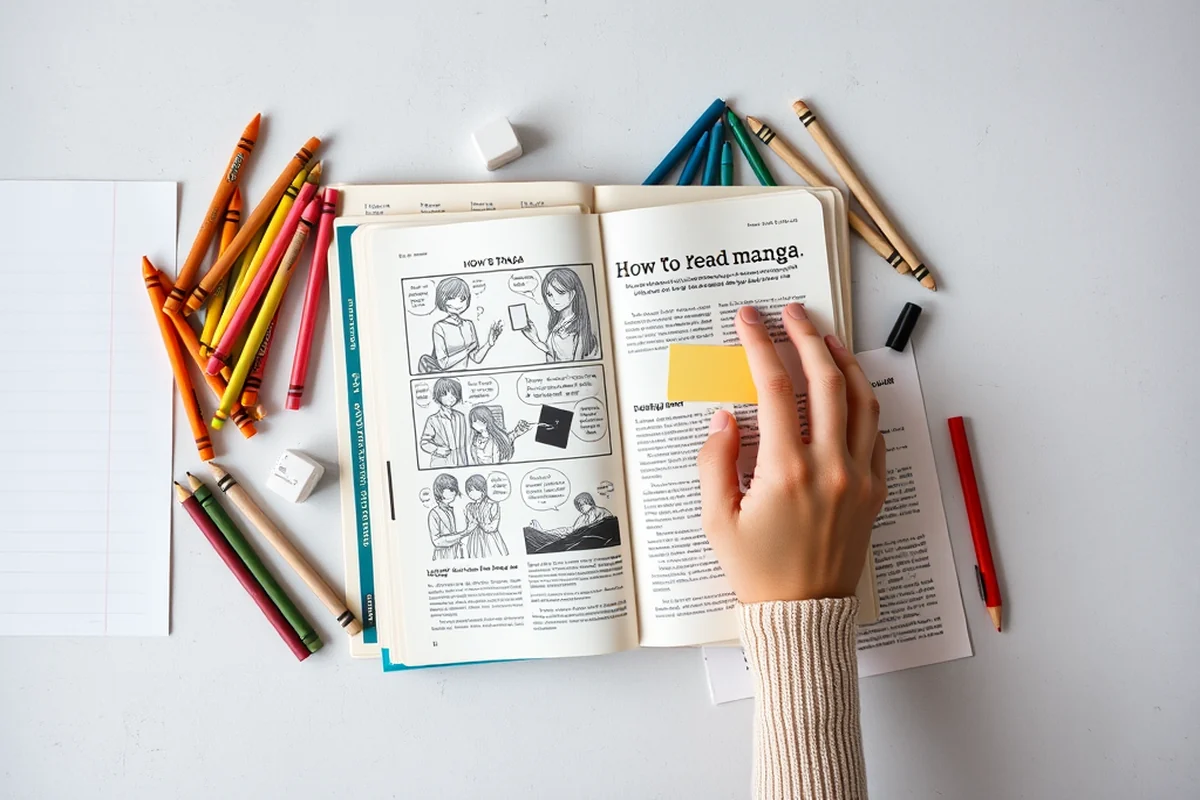
Not all manga are the same. Some are designed for children, while others are written for adults. If you're new to the genre, it's a good idea to start with a manga that's labeled as 'shonen' or 'shojo,' which are typically aimed at younger readers. These are usually easier to follow and have simpler storylines.
I've found that 'One Piece' and 'My Hero Academia' are excellent choices for beginners. Both are widely popular and have clear story arcs that are easy to follow. They also introduce a lot of characters and concepts that can help you learn the format as you go.
If you're looking for something more educational, there are also manga that cover topics like history, science, and even math. These are great for students who want to learn while they read, and they make learning feel like play.
Related: Teacher guided reading
Reading Manga with a Group or Family
Manga is a great activity for families, and it's especially popular with children. When you read together, you can discuss the story, characters, and artwork as you go. This helps build comprehension skills and encourages dialogue. I've seen my own kids learn to read manga more quickly when they're with others, as they're more engaged and excited to participate.
If you're reading with a group, it's a good idea to take turns reading different sections. This helps everyone stay involved and gives them a chance to ask questions. It also makes the experience more interactive and less overwhelming for younger readers.
One of the best things about reading manga with others is that it makes learning how to read manga a shared experience. You can compare notes, discuss what's happening, and even create your own stories based on the ones you're reading. It's a great way to build creativity and critical thinking skills.
Related: Teaching reading jessie wise
Using Printables and Visual Aids
Printables are a great tool for teaching how to read manga, especially for younger children. They can be used to label speech bubbles, identify characters, or track the flow of the story. I've created several printables that help students recognize the different elements of a manga page, and they've been incredibly effective.
Visual aids like flowcharts, diagrams, and annotated pages can also be useful. They help break down complex concepts into simple, visual components that are easier to understand. For example, a diagram that shows the order of panels on a page can help students avoid confusion when they're first learning the format.
Printables and visual aids are also a great way to reinforce learning. They can be used for practice, review, and even for creating your own manga pages. I've found that students who use these tools consistently tend to grasp the concepts faster and retain the information longer.
Visual learning is powerful—especially when it comes to something as visually rich as manga.
Related: Teaching reading book
Exploring Different Genres and Styles
From action-packed shonen series to heartwarming shojo stories, manga has something for everyone. Exploring different genres and styles can help you find the type of story that resonates with you the most. It's also a great way to improve your reading skills and expand your vocabulary.
I've noticed that students who read a variety of manga tend to have a better understanding of different story structures and narrative techniques. They become more familiar with the way stories are told and are able to recognize patterns in the way panels are arranged and used.
If you're looking for something new to read, I recommend exploring different genres and styles. You might be surprised by how much you enjoy a genre you never thought you'd like. It's also a great way to discover new authors and artists whose work you can follow and support.[5]
👦 Younger Kids (Ages 3-6)
Choose simple, colorful manga with large text and minimal dialogue to help younger readers build confidence.
👧 Older Kids (Ages 7-12)
Opt for manga with more complex storylines and detailed artwork to challenge and engage older readers.
📄 No-Prep Version
Use existing manga books and simple printables to create a no-prep learning experience for your child.
👥 Group Reading
Read manga with others to encourage discussion, build comprehension, and make learning more interactive.
🎨 Extension Activity
Create your own manga pages to reinforce learning and encourage creativity in your child.
| The mistake | Why it happens | The fix |
|---|---|---|
| Skipping speech bubbles or small panels | These often contain important details that can change the meaning of a scene or provide context for the story. | Make sure to read every speech bubble and panel, even the small ones. They're there for a reason and can help you understand the story better. |
| Reading the text in the wrong order | Manga is read in a specific order, and skipping panels can make the story confusing or hard to follow. | Look for arrows or page numbers that indicate the order of panels. These are there to help you stay on track and avoid confusion. |
| Ignoring the cultural context of the story | Manga often includes cultural references that can be confusing if you're not familiar with them. | Take time to research the cultural background of the manga you're reading. This can help you understand the story better and appreciate the art and storytelling. |
| Choosing a manga that's too difficult for your skill level | If you choose a manga that's too complex, it can be frustrating and discourage you from continuing to read. | Start with manga that's labeled as 'shonen' or 'shojo,' which are typically aimed at younger readers. These are usually easier to follow and have simpler storylines. |
How To Read Manga
Common Questions
What if I don't understand the Japanese words in the manga?
How do I know where to start reading a manga page?
What should I do if I get lost in a manga chapter?
How can I help my child learn to read manga?
References
- Bande Dessinée: Comics & Graphic Novels - French in Translation (guides.loc.gov)
- LITT: Teens - Idaho Commission for Libraries (libraries.idaho.gov)
- Enrich Iowa Direct State Aid Report (statelibraryofiowa.gov)
- Publication Review Log - Washington State Department of Corrections (doc.wa.gov)
- List Of Genres Of Literature (emergency.jacksonms.gov)
Cite this guide
Teaching Reading to Homeschoolers (2026). How To Read Manga. https://homeschoolread.com/how-to-read-manga/
Feel free to cite or share this guide.
Reading Skills Checklist
Stage-filtered phonics and reading skills checklist for homeschool parents.
Open it free →