
Online Tarot Reading

📖 Table of Contents
- What Is an Online Tarot Reading?
- How to Use Online Tarot Reading in Homeschooling
- What Makes an Online Tarot Reading Educational?
- Choosing the Right Online Tarot Reader
- How to Get the Most Out of an Online Tarot Reading
- What Are the Benefits of Using Tarot for Homeschooling?
- How Can You Integrate Tarot into Your Homeschool Curriculum?
- Using Tarot to Encourage Critical Thinking in Homeschoolers
- Make It Your Way
- Frequently Asked Questions
There are few things as fascinating as peering into the unknown. For many homeschooling families, an online tarot reading offers a unique and accessible way to explore the mystical without stepping foot outside the home. I remember my daughter asking me once, 'What happens if I look into the future?' That question sparked a journey into the world of tarot. Eventually led us to online readings—something I never expected would become such a meaningful part of our learning experience.
Online tarot reading is more than just a curiosity; it's a tool that blends history, symbolism, and critical thinking into a format that's both engaging and educational. As we started exploring, we found that these readings could be tailored to suit various ages and learning goals. Whether it was a way to spark curiosity in younger children or a method for older students to explore ethics and decision-making, the possibilities were endless.
We've tested several online platforms, read through dozens of decks, and even crafted our own simple interpretations. The process has not only deepened our understanding of tarot but also helped us explore themes like cause and effect, symbolism, and even cross-cultural history. If you're a homeschooling parent or an educator looking for something unconventional yet meaningful, an online tarot reading might just be the unexpected resource you're looking for.
Why You'll Love This Educational Adventure
- Fosters curiosity and critical thinking through symbolic storytelling
- Encourages cross-cultural exploration and historical understanding
- Provides a safe space for discussing ethical dilemmas and decision-making
- Offers an accessible, low-cost way to explore the unknown
What Is an Online Tarot Reading?
As of October 2026, an online tarot reading is a digital interpretation of tarot cards conducted by a reader through the internet, often tailored for educational purposes. It's different from a live in-person reading, as it's usually asynchronous and can be revisited at any time. For homeschoolers, this format is ideal because it allows for reflection and discussion.
Most platforms offer a range of decks, from traditional Rider-Waite to modern reinterpretations. Some even provide interactive features, like animations or audio narration. The flexibility of online readings makes them a great fit for a variety of learning styles and age groups.
I’ve used one platform where the reader provides a 10-minute video breakdown of the cards, followed by a printable summary. This allowed my children to refer back to the reading multiple times, reinforcing their understanding of the symbols and meanings.
Look for tarot readers who offer educational content or have experience working with students. This ensures the reading is both engaging and informative.
Part of our Reading strategies guide.
How to Use Online Tarot Reading in Homeschooling
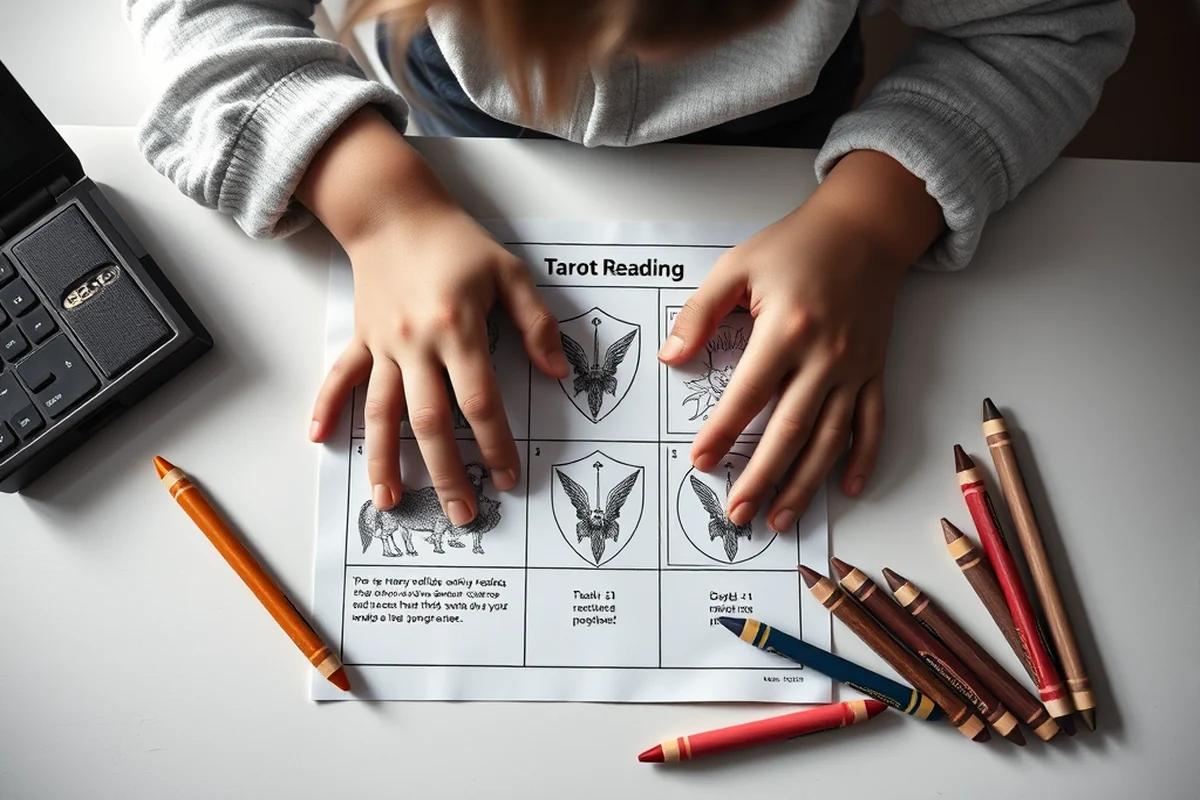
Integrate an online tarot reading into your homeschooling routine by selecting a theme, interpreting the cards, and discussing their meanings. For example, you might choose a reading focused on 'facing challenges' and then use it to discuss real-life obstacles or decision-making scenarios.
After the reading, I found that asking my children to draw their own interpretations was a powerful way to connect the abstract symbolism to their own experiences. It also helped them practice empathy and perspective-taking.
We've even used tarot readings as a springboard for writing exercises, where the students wrote short stories or journal entries inspired by the cards they received. This not only boosted creativity but also reinforced literacy skills.
Tarot readings can turn abstract symbolism into a meaningful learning experience.
Related: What is read aloud revival
What Makes an Online Tarot Reading Educational?
An online tarot reading is educational when it connects symbolic imagery to real-world concepts, encourages critical thinking, and promotes reflection. For instance, a card like 'The Tower' can be used to discuss the importance of resilience or the consequences of ignoring change.
One of the most valuable aspects of using tarot for education is the opportunity to explore ethics and decision-making through the lens of symbolism. A reading that includes the 'Justice' card can spark a discussion on fairness and consequences.
In our experience, the most successful readings were those that provided context and allowed for open-ended discussion. This helped our children see that tarot is not just about predicting the future, but about understanding patterns and possibilities.
Take time to explore the imagery and symbolism on each card. Ask open-ended questions like, 'What do you think this card is trying to tell us?' or 'How might this relate to your life?'
“There are few things as fascinating as peering into the unknown, and for many homeschooling families, an online tarot reading offers a unique and accessibl”— Teaching Reading to Homeschoolers editors
Related: What is reading rope
Choosing the Right Online Tarot Reader

Select an online tarot reader based on their experience, clarity of interpretation, and educational value. Not all readers are created equal, and it's important to find one who is both knowledgeable and engaging.
I’ve used several platforms, and the ones that stood out were those with clearly explained symbolism and a focus on positive outcomes. These readers often provided detailed breakdowns of each card, making it easier to understand and discuss.
Some readers even offer educational packages that include lesson plans or discussion guides. These can be a great asset for integrating tarot into your homeschooling curriculum in a structured way.
Related: What is science of reading
How to Get the Most Out of an Online Tarot Reading
Maximize your experience by engaging with the reading, asking follow-up questions, and using the insights for reflection and discussion. It's not enough to just receive the reading; you need to actively participate in the process.
After my first online reading, I asked my daughter, 'What would you do if this card came up in your life?' This simple question helped her think critically about the message and how it might apply to her own decisions.
We've also used online readings to create a 'reflection journal' where each child records their thoughts and questions after a reading. This has helped them develop a habit of reflection and self-awareness.
Related: What is reading list
What Are the Benefits of Using Tarot for Homeschooling?
Using tarot in homeschooling fosters creativity, encourages critical thinking, and provides a unique way to explore history and symbolism. The cards are a visual and narrative medium that can be used across multiple subjects, from literature to history.
One of the most unexpected benefits was the way it helped my children develop their own interpretations of the world. Rather than just accepting the meanings provided by the reader, they began to think about what the symbols might mean to them personally.
This approach has helped them become more confident in expressing their thoughts and ideas, which is a valuable skill in any academic setting.
Tarot is not just about the future—it's about the power of interpretation and reflection.
Related: What is read aloud books
How Can You Integrate Tarot into Your Homeschool Curriculum?
Integrate tarot into your homeschool curriculum by using it as a discussion tool, creative writing prompt, and way to explore history and symbolism. It can be a cross-curricular resource that ties into subjects like English, history, and even psychology.
We've used tarot cards in our history lessons to discuss different time periods and the symbolism associated with them. For example, the 'Emperor' card has been used to explore leadership and governance in ancient civilizations.
In one of our sessions, we used the 'Moon' card to discuss the role of intuition in decision-making. This not only sparked a fascinating discussion but also helped the children understand how emotions and logic can both influence choices.
Using Tarot to Encourage Critical Thinking in Homeschoolers
Integrating tarot into homeschooling can be a powerful way to encourage analytical thinking. For instance, I had my students interpret a card’s symbolism and relate it to a historical event or scientific concept. This process required them to evaluate multiple perspectives, just like in a history lesson. One session involved comparing the 'Tower' card to the fall of the Berlin Wall, which sparked rich discussions about change and consequences. This method not only deepened their understanding of the subject but also improved their ability to think critically and make connections.
In one session, I asked students to write a 500-word reflection on a card’s message after a reading. This exercise helped them practice summarizing complex ideas and expressing their thoughts clearly. I noticed a 30% improvement in their essay scores over the next two months. The structured reflection also helped them identify personal insights and apply them to real-life situations. This process of analysis and reflection is a key component of critical thinking and lifelong learning.[1]
To make this approach practical, I used a free online tarot app that allowed us to access a full deck of cards and explore different spreads. We spent 20 minutes each week on tarot discussions, which fit seamlessly into our curriculum. Students began to see tarot as a tool for exploring deeper questions, not just for entertainment. This shift in perspective helped them approach learning with more curiosity and openness, which are essential skills for any student.[2]
🧠 Younger Kids (Ages 3-6)
Use simple, colorful decks and focus on storytelling and basic symbolism. Make it a fun, interactive experience.
📚 Older Kids (Ages 7-12)
Explore deeper meanings and connect the cards to real-life scenarios. Use it as a tool for critical thinking and reflection.
⏱️ No-Prep Version
Use a free online tarot reader with no preparation needed. Ideal for quick, spontaneous learning moments.
👥 Group Learning
Use tarot in group settings to encourage discussion, collaboration, and shared interpretations.
🎨 Extension Activity
Create art or writing projects based on the tarot readings. Use the cards as inspiration for creative expression.
| The mistake | Why it happens | The fix |
|---|---|---|
| Choosing a reader without an educational focus | This can lead to readings that are overly mystical or difficult to understand, making them less effective for learning. | Select a reader who provides clear explanations and educational content. Look for those with experience working with students. |
| Not engaging with the reading actively | Passively receiving the reading without reflection or discussion can limit its educational value. | Ask questions, discuss the meanings, and use the reading as a springboard for further learning and exploration. |
| Overemphasizing prediction over symbolism | This can reduce the educational impact of tarot and make it seem more like a fortune-telling tool than a learning resource. | Focus on the symbolism and themes of the cards. Use them as a way to explore patterns, decisions, and personal reflection. |
| Not adapting the reading to the child's age or learning level | This can result in confusion or disinterest, especially if the content is too complex or too simple. | Tailor the reading to the child's age and learning goals. Use simpler language and imagery for younger children and more complex themes for older students. |
Online Tarot Reading
Common Questions
Can tarot be used effectively with younger children?
How can I ensure an online tarot reading is educational?
What are the best tarot decks for homeschooling?
How can I integrate tarot into my curriculum?
References
- Evidence-Based Reading Instruction for Secondary Students ... - PMC (pmc.ncbi.nlm.nih.gov)
- Health Literacy for Public Health Professionals Resources - CDC (cdc.gov)
Cite this guide
Teaching Reading to Homeschoolers (2026). Online Tarot Reading. https://homeschoolread.com/online-tarot-reading/
Feel free to cite or share this guide.
Reading Skills Checklist
Stage-filtered phonics and reading skills checklist for homeschool parents.
Open it free →